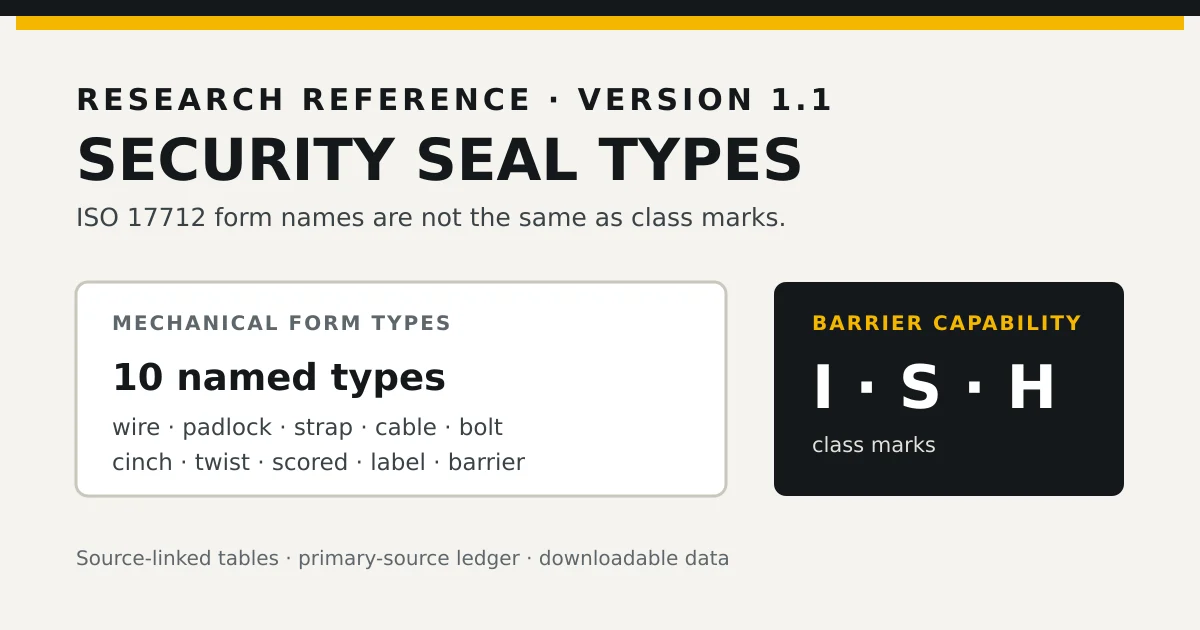
What are the key security seal facts?
ISO 17712:2013 defines ten mechanical security seal types by name; I, S and H are three class marks, not three physical types. This reference separates the standard’s definitions, published model specifications and the U.S. provisions that apply to particular shipments. 1
-
ISO 17712:2013 defines exactly ten mechanical seal types by name: wire, padlock, strap, cable, bolt, cinch (pull-up), twist, scored, label and barrier. This is the count in Clause 3.2, not a count of every product sold as a security seal. Source: ISO 17712:2013, Clause 3.2. Verified September 15, 2026. 1
-
The three ISO 17712 class marks — I, S and H — describe increasing barrier capability, not a guarantee that tampering is impossible. Tamper evidence is required across the classes; high-security seals also have documented tamper-resistance requirements. Source: ISO 17712:2013, Clauses 4.2.3, 4.4.1 and 5.1.1. Verified September 15, 2026. 1
-
18 U.S.C. § 2117 generally provides a maximum of ten years in prison for breaking a qualifying freight conveyance’s seal or lock, or entering it, with intent to commit larceny. The statute includes a separate punishment cross-reference for pre-retail medical products; breaking a seal without the required criminal intent is not the offence described here. Source: U.S. Congress, 18 U.S.C. § 2117. Verified September 15, 2026. 7
-
Four cable seals in Universeal UK’s Flexigrip line span three publisher-declared ISO classifications: the 1.5 mm model is Indicative, the 2.5 mm model Security, and the 3.25 mm and 5 mm models High Security. Their published body dimensions also differ; cable diameter is not the only changing feature. Source: Universeal UK’s four model pages, reviewed September 15, 2026. 14, 15, 16, 17
-
ISO 17712:2013’s strength-classification procedure uses 25 samples across five tests, and the lowest classification returned by any sample on any test governs the model. Indicative seals need not undergo these strength tests. Source: ISO 17712:2013, Clause 5.1.1. Verified September 15, 2026. 1
-
19 CFR § 24.13a accepts a manufacturer’s attestation that a seal has been tested and meets paragraphs (a)–(d); it does not eliminate Customs’ right to test accepted seals. Pre-acceptance testing is performed by the manufacturer or a private laboratory. Source: U.S. Customs and Border Protection, 19 CFR § 24.13a(e)–(f). Verified September 15, 2026. 10
-
ISO-related sealing requirements are not limited to voluntary CTPAT membership. CBP’s August 7, 2008 notice explains a separate statutory ISO/PAS 17712 requirement for loaded maritime containers arriving in the United States from October 15, 2008, including foreign cargo remaining on board and subject to stated unsealable-container exclusions. Source: CBP Decision 08-30 and 6 U.S.C. § 944. Verified September 15, 2026. 23, 24
-
An I-class seal need not undergo ISO 17712:2013’s Clause 5 strength tests. That is an exemption from a requirement, not evidence that a particular product has never been tested. Source: ISO 17712:2013, Clauses 3.1.4 and 5.1.1. Verified September 15, 2026. 1
-
ISO 17712:2013 specifies a minimum 18 mm dimension for the relevant bolt-seal metal head/body components; this is not an 18 mm minimum bolt-shaft diameter. Its explanatory note describes 17 mm components being pulled intact through worn container hasps. Source: ISO 17712:2013, Clause 4.1.3 and its note. Verified September 15, 2026. 1
-
19 CFR § 24.13(f) sets ten cents per seal for in-bond and in-transit seals sold by port directors, except high-security red in-bond seals, which use the manufacturer’s current list price for the quantity purchased. This is a specified government-sale price, not an average retail seal price. Source: U.S. Customs and Border Protection, 19 CFR § 24.13(f). Verified September 15, 2026. 9
-
Universeal UK publishes a 330 kgf break strength for its 1.5 mm Flexigrip 150M while declaring that model Indicative. The product’s break-strength figure is not a substitute for the complete ISO classification evidence. Source: Universeal UK, Flexigrip 150M specification, reviewed September 15, 2026. 14
-
The ISO 18185 electronic-seal series has five parts, including Part 4 on data protection. Part 2 expressly links an electronic seal’s mechanical characteristics to ISO 17712 high-security provisions; electronic and mechanical requirements are not mutually exclusive. Source: ISO 18185 catalogue entries and ISO 18185-2:2007, Clauses 3.1 and 4.7. Verified September 15, 2026. 2, 3, 4, 5, 6
-
Florida’s 2026 theft statute grades qualifying cargo below $50,000 as second-degree grand theft without stating a minimum value in that cargo paragraph, and cargo worth $50,000 or more as first-degree grand theft. The specified commerce window runs from the shipper’s loading platform to the consignee’s receiving dock. Source: Florida Legislature, § 812.014(2)(a)2 and (2)(b)2. Verified September 15, 2026. 13
-
Eight of the eleven pages in this September 2026 audit could be reviewed sufficiently for selected-list counts; those lists contain two to eight entries. They group different concepts — physical forms, functions, catalogue categories or security classes — and the three unavailable pages are excluded from the range. Source: Lakeland Dock Door Repair’s published taxonomy audit, version 1.1, September 15, 2026. Table 7
-
CargoNet estimated nearly $725 million in U.S. and Canadian cargo-theft losses in 2025, with 2,646 confirmed cargo thefts and an average reported loss of $273,990. It reported a 60% increase in estimated losses and an 18% increase in confirmed cargo thefts; its broader supply-chain-crime count is a different denominator. Source: Verisk CargoNet, January 21, 2026 release. Verified September 15, 2026. 18
Security seal types and security seal classes are two different systems. ISO 17712:2013 names ten mechanical seal types and uses three class marks — I, S and H. Most individual type definitions do not assign a class; the cinch definition expressly identifies an indicative seal. One supplier’s four-model cable range carries three different declared classifications, despite all four models belonging to the cable family. The shape on the box is not classification evidence. The specific model and its documentation matter. 1, 14, 15, 16, 17
Contents. Jump to: Key security seal facts · What are the security seal types? · What do I, S and H mean? · How does a seal get its classification? · What does U.S. law require? · Are electronic seals security seals? · What happens if someone breaks a seal? · Why does this matter in Florida? · How was this assembled? · What does this show? · Which figures are excluded? · What is in the dataset? · What is the citation reference? · Questions · Sources
A note on the word “seal.” This page is about cargo security seals: devices whose identity and condition help document whether a trailer or container’s sealed access point has been interfered with. It is not about environmental dock seals, such as the foam pads around a dock door that compress against a parked trailer. Those close an environmental gap; they are not the numbered cargo-security devices discussed below. 1, 26
What are the security seal types?
There are ten named mechanical types in ISO 17712:2013, the standard covering classification, acceptance and withdrawal of mechanical freight-container seals. Clause 3.2 defines each by name; a catalogue’s material or application categories answer a different question. 1
That distinction matters more than it sounds. A catalogue may group seals by what a buyer shops for: plastic ones over here, metal ones over there. The standard’s list describes particular forms and closure arrangements, while its separate class scheme addresses barrier capability. The schemes overlap, but they are not interchangeable. 1, Table 7
Table 1. The ten mechanical seal types defined in ISO 17712:2013
| # | Seal type | What it is | Variants named in the standard | Class set by the definition? |
|---|---|---|---|---|
| 1 | Wire seal | A length of wire closed into a loop by a seizing device. Deformation of that device is one of the tamper indications. | Crimp wire, fold wire, cup wire | No |
| 2 | Padlock seal | A locking body with a bail attached. The standard notes that the padlock is not an integral part of the container. | Wire shackle padlock (metal or plastic body), plastic padlock, keyless padlock | No |
| 3 | Strap seal | A metal or plastic strap looped by pushing one end into a covered locking mechanism on the other end. | Not enumerated | No |
| 4 | Cable seal | A cable plus a locking mechanism. One-piece designs carry the lock permanently on one end of the cable; two-piece designs use a separate lock that slips on. | One-piece, two-piece | No |
| 5 | Bolt seal | A metal rod — threaded or unthreaded, flexible or rigid — with a formed head, closed by a separate locking mechanism. | Threaded, unthreaded, flexible, rigid | No |
| 6 | Cinch seal (pull-up seal) | A thin strip, serrated or plain, with a lock on one end; the free end is drawn through a hole in the lock and pulled tight. May have several lock positions. The standard notes it can resemble an electrical tie but is significantly different. | Serrated, non-serrated | Yes — defined as an indicative seal |
| 7 | Twist seal | A steel rod or heavy-gauge wire whose closure uses twisting; the definition refers to a special tool. | Various diameters | No |
| 8 | Scored seal | A metal strip scored across its width, designed so that removal breaks the strip at the score. | Not enumerated | No |
| 9 | Label seal | A frangible paper or plastic backing with adhesive, chosen so the seal tears when removal is attempted. | Paper backing, plastic backing | No |
| 10 | Barrier seal | A seal designed to present a significant barrier to entry. It may enclose part of the container's inner locking rods. The standard notes that barrier seals can be designed to be reusable. | Not enumerated | No |
Source: ISO 17712:2013, Clause 3.2. Definitions summarised, not reproduced as standard text. Verified September 15, 2026. 1
The one type the standard pins to a class
Nine of the ten individual type definitions do not assign a class. The tenth does.
The cinch or pull-up seal is defined in Clause 3.2.6 as an indicative seal. Its thin strip can be serrated or plain; the definition does not make “plastic” itself the classification. Nor does the absence of a class in the other nine definitions prove that every design within those types could qualify for every class. It means the type name alone does not establish the model’s classification. 1
That is why “cable seals are high security” is too broad. A cable seal’s declared class can differ by model, and the four products below demonstrate exactly that. The comparison does not certify those products or establish a universal diameter-to-class rule. 14, 15, 16, 17
Table 2. Catalogue terms that do not establish an ISO 17712 class
These terms appear in the reviewed supplier and reference material. They can be useful descriptions, but a material, application or marketing label is not a substitute for the exact physical type and model-level classification evidence. 1, 28, 29, 30, 31, 32, 33, 34, 35
| Term in common use | What it describes in the reviewed material | Where it sits against the defined terms |
|---|---|---|
| Metric seal | An entry in SealValue’s separate five-item list. | The term is not one of the ten Clause 3.2 type names. The page does not establish an ISO class for it. |
| Adhesive seal / security tape | Adhesive labels, stickers and tape categories. | Adhesive label designs can overlap the standard’s label seal definition; a generic tape description does not establish conformity with the container-seal standard. |
| Plastic seal | A material grouping covering different closure designs. | Can describe cinch, padlock or strap forms. Material alone is not a class. |
| Metal seal | A material grouping covering different closure designs. | Can include strap, scored, wire and other forms. Material alone is not a class. |
| Meter seal | An application label used in seal selection material. | The application does not establish which physical form or security class a particular model has. |
| Truck seal / railcar seal | An application or conveyance label. | ISO 17712 says conforming seals can also be used on bulk railcars and truck trailers in cross-border and domestic operations. |
| Zip-tie seal | A description that can resemble a cinch seal or an ordinary cable tie. | ISO 17712 explicitly notes that cinch seals can resemble electrical ties while being significantly different. |
| Tamper-proof seal | An absolute marketing assurance. | Not an ISO 17712 class. The standard addresses tamper evidence and specified barrier/tamper-resistance requirements, not an assurance of invulnerability. |
Source: ISO 17712:2013, Clause 3 and scope; the individual pages in the published taxonomy audit. Catalogue terms were checked September 15, 2026. No claim is made that a term is absent from every other standard. 1, 28, 29, 30, 31, 32, 33, 34, 35
What do the letters I, S and H on a security seal mean?
They mean Indicative, Security and High Security, describing increasing barrier capability under ISO 17712. The standard’s note says the class names do not themselves imply differences in security against tampering, but other clauses still require tamper evidence and impose additional documented requirements on high-security seals. 1
“High security” is not a promise that a seal cannot be defeated without discovery. It is also not simply a claim that a seal is hardest to cut: the classification procedure includes tensile, shear, bending and impact tests. No cutting-time guarantee follows from the letter H. 1
The practical consequence is straightforward. A class mark and a complete security system are not the same thing. The mark cannot, by itself, establish that a specific shipment remained intact; the seal’s identity, condition and handling records still matter. ISO’s own introduction places effective sealing inside proper selection, storage, accounting, application and documentation. 1
Table 3. One supplier, one product line, three declared classes
Universeal UK’s Flexigrip cable seal range provides a published demonstration that physical type does not determine class. The four pages describe an aluminium-alloy body, a zinc-alloy-and-steel locking mechanism, and non-preformed galvanised aircraft cable. Their body dimensions are not all identical, and no conclusion about material equivalence beyond those published descriptions is made here. 14, 15, 16, 17
| Model | Cable diameter | Published body dimensions | Publisher-declared classification | Published break strength | Listed removal method |
|---|---|---|---|---|---|
| Flexigrip 150M | 1.5 mm | 26 × 22 × 6 mm | ISO 17712:2013 I / Indicative | 330 kgf | Cable cutters |
| Flexigrip 250M | 2.5 mm | 26 × 22 × 6 mm | ISO 17712 S / Security | 600 kgf | Cable cutters |
| Flexigrip 325M | 3.25 mm | 26 × 26 × 7.5 mm | ISO 17712 H / High Security | 1,193 kgf | Cable cutters |
| Flexigrip 500M | 5 mm | 30 × 38 × 10 mm | ISO 17712 H / High Security | 2,035 kgf | Cable cutters |
Source: Universeal UK’s individual Flexigrip 150M, 250M, 325M and 500M product pages, reviewed September 15, 2026. These are publisher declarations, not independent results or confirmation of current certification. Edition years are not supplied where absent from the reviewed classification wording. The removal column transcribes the product listing; it is not a removal procedure. 14, 15, 16, 17
Three things worth pulling out of that table.
The selected Security and first High Security models have cable diameters of 2.5 mm and 3.25 mm, a difference of 0.75 mm. But their body dimensions differ too. This is a comparison of two named models, not evidence that increasing any cable by three-quarters of a millimetre produces an H-class seal. 15, 16
The Indicative model publishes a 330 kgf break strength and lists cable cutters for removal. That tells us what this supplier declares for this model; it does not reveal which classification tests were performed, or why a particular certification route was or was not used. “Indicative” cannot be reverse-engineered into a complete test history from one product page. 14
And the supplier itself distinguishes the classifications in its range. The 150M description directs readers toward other models when high-security classification is needed. The useful point is the distinction within one product family, not a recommendation of one product over another. 14
Why a published strength number cannot tell you the class
Here are two different comparisons, and they should not be confused.
The Indicative Flexigrip 150M publishes a break strength of 330 kgf. YouMeSeal’s classification article gives a purported S-class tensile minimum as 231 kg, also expressed there as 2.27 kN. Those statements are attributed to their publishers; neither the terminology nor the complete test conditions are established as comparable by the two pages. A product’s break strength and a multi-test classification need not contradict one another. 14, 34
There are several reasons not to infer a class from that comparison. A supplier’s break-strength measurement may not use the standard’s tensile procedure, the classification depends on the lowest result across the required tests, and a freely published threshold summary may itself be inaccurate. The product page does not disclose enough evidence to select one explanation as the answer for this model. 1, 14
A separate, genuine disagreement exists between the two supplier summaries: Lockwise publishes at least 1 kN as an S-class tensile minimum, while YouMeSeal publishes 2.27 kN. Those are different claims about the purported threshold. We did not independently verify either against ISO 17712’s Table 1, so neither is presented as the correct requirement. 34, 35
The working rule survives both comparisons: do not infer a class from an isolated strength number, and do not treat a product-page class claim as the complete model-specific evidence behind it. The comparison records published statements; it does not validate the statements by repeating them.
Who is allowed to stamp the letter on
Not the manufacturer acting solely on an unsupported declaration. Under ISO 17712:2013, applying a class mark depends on physical-parameter certification from an accredited testing facility and review of security-related manufacturer practices by an accredited process-review organisation. For H specifically, the standard also describes documentation of tamper-evident features through a compliance-certification letter and an audit report. 1
The testing and process-review functions are not a claim that two legally separate organisations must always be hired. Likewise, the cited wording should not be reduced to an invariant document count detached from the actual model and certification arrangement. What matters is whether the required evidence and appropriately accredited functions are present. 1
ISO/IEC 17025 and ISO/IEC 17020 are standards relevant to those conformity-assessment functions; they are not organisations that themselves accredit anyone. Clause 5.1.2 calls for independent testing by an ISO/IEC 17025-accredited laboratory with an explicit scope covering ISO 17712. A product page saying “high security” is not that paper trail. 1
How does a seal get its classification?
ISO 17712:2013 specifies four physical test procedures, with impact performed at two temperatures, making five tests for strength classification. Five samples per test make twenty-five samples, and the lowest classification returned by any sample on any test defines the model’s result. 1
The procedures cover tensile, shear, bending and impact performance. In the tensile procedure specifically, the stated pulling speed is 50.8 ± 25.4 mm per minute, and the stated test temperature is 18 ± 3 °C. That temperature statement must not be misreported as applying to every test: the impact procedure uses two temperatures. These are descriptions of laboratory provisions, not directions for improvised seal testing. 1
The rule that matters most is how the results combine. The lowest classification returned by any sample on any test defines the seal. To reach a class under this procedure, the model cannot rely on its best sample or strongest single test. One lower result governs rather than being averaged away. 1
Two consequences follow, and both are checkable.
Indicative seals need not undergo the Clause 5 strength tests. The definition describes seals that can be broken by hand or with a simple snipping or shearing tool. That exemption does not prove that a supplier never tested a product, and it is not an independently measured failure rate for all indicative seals. 1
And test evidence is dated. Clause 5.1.2 calls for testing to be repeated every two years unless a meaningful design or material change, or a competent authority’s requirement, calls for it sooner. That is a retesting provision, not permission to declare every certificate automatically expired on the same schedule without inspecting the actual documentation. 1
Bolt seals carry an extra dimensional hurdle separate from strength classification. Clause 4.1.3 addresses the minimum diameter or minimum widest cross-dimension of the relevant metal pin-head/locking-body components, with an 18 mm minimum. Its own note explains the concern: 17 mm components could pass intact through worn container hasps. The provision does not demand an 18 mm bolt shaft, and an outer plastic coating should not be substituted for the specified metal measurement. 1
That is a useful distinction to preserve in a reference: a component dimension, a laboratory strength result and a complete security classification are different facts. They should occupy different fields in a specification, not be collapsed into a single reassuring number.
The threshold numbers we did not publish
ISO 17712’s Table 1 contains classification threshold values. It was outside the preview reviewed for this reference. The standard is copyrighted and sold by ISO; the definitions and passages used here are summarised, and its test tables are not reproduced. 1
What we did record is the disagreement between freely available restatements. Lockwise’s 1 kN and YouMeSeal’s 2.27 kN purported S-class tensile minima differ by a factor of 2.27. The calculation is reproducible, but the ratio measures disagreement between two published statements — not a spread in the standard’s requirements. 34, 35
For the I class, the primary text resolves the requirement question without requiring a guessed numerical ceiling: indicative seals need not be subjected to the Clause 5 strength tests. A supplier’s description of their usual strength is not automatically an ISO class boundary. We therefore publish neither of the disputed S values, nor a supplier-described I ceiling, as an authoritative ISO threshold. 1
What does U.S. law actually require of a security seal?
There is no single rule that answers for every shipment. Customs acceptance standards, in-bond transport rules, a statutory maritime-container sealing requirement and CTPAT membership criteria have different scopes; ISO-related sealing is not confined to a voluntary programme. 8, 9, 10, 11, 12, 23, 24
The distinction is not “mandatory rules are loose, voluntary rules are strict.” It is which instrument applies, to which container or shipment, and what that instrument actually says. Section 24.13a’s acceptance provisions are only one part of that answer.
The six federal standards
Under 19 CFR § 24.13a(a), a seal and its fastening, taken together, must be strong and durable; capable of being affixed easily and quickly; capable of being checked readily and identified by unique marks and numbers; incapable of removal or undoing without breaking, or of tampering without leaving traces; incapable of being used more than once; and made as difficult as possible to copy or counterfeit. 10
Those are the six general standards in paragraph (a), not the entire section and not the whole body of U.S. seal law. Paragraphs (b)–(d) add seal, fastening and marking specifications. They address such matters as legibility, appropriate materials, resistance to deterioration and a fastening that does not permit opening or partial opening without breakage or obvious damage. The section itself supplies no numerical ISO tensile threshold. 10
How a seal becomes acceptable to Customs
By a manufacturer’s attestation of testing against the specified requirements, not by an unqualified marketing claim. Paragraph (e) provides that seals are considered acceptable for use or purchase by Customs once the manufacturer attests that they have been tested and meet or exceed paragraphs (a)–(d). They remain acceptable until shown not to meet those standards. A manufacturer can attest for a specific seal or a product line as of a stated date; adding another seal to that line requires specific acceptance of that seal. 10
Paragraph (f) distinguishes when Customs does and does not test. Testing deemed necessary before acceptance is performed by the manufacturer or a private laboratory, not Customs. Customs expressly reserves the right to test, or have tested, seals it has already accepted. “Customs does not test seals” would omit that second sentence and misstate the rule. 10
This is an attestation-based acceptance provision. Its source note records publication as T.D. 81-185 in 1981 and amendment by T.D. 91-77 in 1991. That history does not make it the only applicable authority, and an acceptance under this section does not itself establish compliance with every programme, route or contractual requirement. 10
Table 4. Customs seal colours, uses and specified procurement prices
The regulation describes colours, markings and uses separately from ISO’s class marks. The seven rows below are editorial groupings of those provisions, including yellow and green entries; they are not a claim that the regulation enumerates seven mutually exclusive physical seal types.
| Kind or colour/use entry | Marking or description in the provision | Used for | Who may obtain it / procurement qualification | Price stated for the relevant transaction |
|---|---|---|---|---|
| Red in-bond | “U.S. Customs in Bond” | Imported merchandise shipped between U.S. ports | Eligible parties under paragraph (f), including specified bonded parties, qualifying nonbonded carriers and an approved carrier representative | 10 cents when sold by a port director; not a general manufacturer price |
| High security red in-bond | “U.S. Customs in Bond” | The high-security red designation for that in-bond use | Paragraph (f)’s eligible parties and approved representative provisions | Current manufacturer’s list price for the quantity purchased when sold by a port director |
| Blue in-transit | “U.S. Customs In-Transit” | Merchandise transiting foreign territory or waters between U.S. ports under § 123.24 | Bonded or other carriers; approved carrier representatives for blue seals | 10 cents when sold by a port director |
| Uncolored Customs, other purposes | “U.S. Customs” | The other Customs purposes specified in paragraph (b), distinguished from in-transit use | Not purchasable by private interests; port directors furnish them for authorised use | Without charge, subject to the separate uncolored in-transit exception |
| Yellow in-transit | Railcar marking includes “U.S. Customs” and “Can. Transit”; sample-container marking is “United States-Canada Customs” | Rail shipments and commercial travellers’ samples transiting Canada between U.S. ports under the cited provisions | In-transit procurement rules in paragraphs (c) and (f) | Paragraph (f)’s 10-cent port-director-sale rule applies to in-transit seals |
| Green entries in the procurement provisions | Paragraph (c) describes green in-transit orders and green strap-in bond seals for railroad cars | Specified Canada-related ordering and railcar arrangements | The text specifies Canadian approval for green in-transit orders and a consignment/storage condition for green railcar strap seals | Paragraph (c) supplies no separate green-seal retail price; paragraph (f) governs the specified port-director sales |
| Uncolored in-transit | Commercial travellers’ sample containers under § 123.52 use “Canada-United States Customs” | The separately described in-transit use | Express exception to the no-private-purchase rule for other uncolored Customs seals; paragraph (c) includes a Canadian ordering provision | 10 cents when sold by a port director under paragraph (f) |
Source: U.S. Customs and Border Protection, 19 CFR § 24.13(b), (c) and (f), read September 15, 2026. The eCFR displayed Title 19 current through September 11, 2026. These are provisions in the regulation, not a current stock-availability survey or instructions for placing an order. 9
The ten-cent figure is not a typo. It is the amount in paragraph (f) for the transactions that paragraph describes. But it is not a price for any commercial cargo seal bought anywhere, and “high security red” in this Customs provision is not, by itself, proof of an ISO H classification. 9
The section carries a December 31, 1963 Federal Register source citation and an editorial direction to consult later amendments. That source note does not establish that the ten-cent amount has remained unchanged continuously since 1963. The defensible statement is the current-text price, its paragraph and its scope. 9
When sealing is required at all
Not on every load under one universal rule. Section 18.4 generally requires conveyances, compartments or containers carrying in-bond merchandise to be sealed, with seals remaining intact until arrival at the destination or export port. It refers to §§ 24.13 and 24.13a for the seals and sealing method. 8
That section also contains waivers and specific arrangements, including commingled merchandise, particular package-level sealing or warning-label provisions, and TIR-related conditions. CBP can waive sealing where it determines it is unnecessary to protect the revenue or prevent customs-law violations. A summary of the general rule should not erase those qualifications. 8
The section handles circumstances in which a seal must come off in transit. It authorises a responsible carrier agent to oversee removal and onward resealing when a transfer, casualty or another stated good reason makes that necessary, and requires updated seal numbers to be transmitted to CBP under the referenced provision. This is a description of authorised handling and records, not permission for an unauthorised person to break a seal. 8
There is a separate maritime provision. 6 U.S.C. § 944 contains an ISO/PAS 17712 sealing requirement, and CBP Decision 08-30 explains its application to loaded containers arriving by vessel at a U.S. port of entry from October 15, 2008. The notice includes foreign cargo remaining on board and identifies exclusions for containers that cannot readily accommodate the specified seal, such as the tank, open-top and custom-built examples it names. 23, 24
That notice is explicit that the requirement is statutory, not dependent on CTPAT membership. It also uses the wording ISO/PAS 17712; it should not be silently rewritten as a quotation requiring the 2013 H class. The statute includes implementation and cessation conditions, while the notice documents the resulting 2008 implementation. The applicable text, shipment scope and required edition should be kept distinct. 23, 24
The CTPAT requirement is a programme criterion, not the whole legal answer
CTPAT — Customs Trade Partnership Against Terrorism — is a voluntary partnership programme. Its membership conditions are separate from the generally applicable statutory and regulatory provisions above. Describing CTPAT as voluntary does not make every ISO-related sealing obligation voluntary. 11, 23, 24
The CBP-authored October 2021 Minimum Security Criteria for U.S. Importers supplies the document-specific detail used here. Criterion 6.2 calls for sealable CTPAT shipments to receive a high-security seal meeting or exceeding the most current ISO 17712 high-security standard, and identifies qualifying cable and bolt seals as acceptable. Criterion 6.5 requires members maintaining seal inventories to document compliance; its guidance identifies a laboratory testing certificate as acceptable evidence. 12
The same document’s criterion 6.1 addresses written seal-control procedures, including an annual review, incident documentation and controls over issuing and tracking seals. Criteria 6.6 and 6.7 address seal audits and verification. These references identify the U.S.-importer document and its October 2021 date, not a newly issued 2026 document or a claim that every participant category has identical wording. 12
The document was read as a hosted copy of CBP’s own publication because the agency-hosted download blocked automated retrieval. Its authorship, title and date are preserved in the source list. Laboratory-accreditation statements on this page are separately tied to the ISO clause actually reviewed, rather than to an unread historical bulletin. 1, 12
One more distinction for compliance writers: the older name and the current standard are not interchangeable. ISO’s catalogue shows ISO/PAS 17712:2003, ISO/PAS 17712:2006, ISO 17712:2010 and ISO 17712:2013 in the predecessor sequence. The 2010 edition was an ISO standard, not an ISO/PAS edition. 1, 19, 20
A withdrawn standard reference is not automatically an invalid legal or contractual reference. Indeed, the maritime statute and notice preserve ISO/PAS wording. The useful editorial rule is to name the exact instrument and edition being discussed, then separately identify the current standard where relevant. Substituting “latest” for an adopted reference can change the meaning. 19, 20, 23, 24
Table 5. The principal instruments covered in this reference
| Instrument | Citation / edition | Issuer | Type | What it does | When it applies |
|---|---|---|---|---|---|
| ISO 17712:2013 | Second edition, May 2013 | ISO / TC 104 | International standard | Defines ten physical types; includes class marking, testing and manufacturer-practice provisions. ISO’s catalogue identifies it as current. | Where an applicable requirement or specification adopts it |
| ISO/PAS 17712:2003 and 2006; ISO 17712:2010 | Historical predecessor sequence | ISO / TC 104 | Superseded specifications and standard | Distinguishes the PAS predecessors from the 2010 standard and the 2013 successor. | Legal effect depends on the adopted reference, not withdrawal status alone |
| ISO 18185 series | Parts 1:2007, 2:2007, 3:2015, 4:2007, 5:2007 | ISO / TC 104 / SC 4 | International standards | Electronic seal communication, application, environmental, data-protection and physical-layer subjects; Part 2 also references mechanical high-security requirements. | Where adopted or specified |
| ISO/IEC 17025 | Referenced in ISO 17712:2013 | ISO / IEC | Conformity-assessment standard | Relevant competence requirements for the testing laboratory; not an accrediting organisation itself. | As required for the applicable conformity-assessment function |
| ISO/IEC 17020 | Referenced in ISO 17712:2013 | ISO / IEC | Conformity-assessment standard | Relevant to the inspection/process-review function; not an accrediting organisation itself. | As required for the applicable conformity-assessment function |
| ISO/IEC 15417 | ISO 17712 Clause 4.2.6 | ISO / IEC | Symbology standard | Code 128 is specified where a barcode is applied and there is no contrary customer specification. | Under the cited provision; a barcode does not establish class |
| ASTM F1157-04(2023) | 2023 reapproval | ASTM International | Standard practice | Classifying relative physical performance of security seals; catalogue title and scope verified here. | Where adopted or specified; no test values reproduced here |
| ASTM F1158-94(2023) | 2023 reapproval | ASTM International | Standard guide | Inspection and evaluation of tampering; referenced by ISO 17712 for field/training use. | Where adopted or specified; full guide not reviewed here |
| 6 U.S.C. § 944 | (a)(4)(B) | U.S. Congress | Federal statute | Contains the ISO/PAS 17712 sealing provision, including implementation and cessation conditions. | Within its statutory scope |
| Container Seals on Maritime Cargo | CBP Decision 08-30; 73 FR 46029–46030, August 7, 2008 | CBP | Agency notice explaining statute | Describes loaded maritime-container scope, October 15, 2008 effective date and unsealable-container exclusions. | Explains a statutory obligation, not a CTPAT-only condition |
| 18 U.S.C. § 2117 | Breaking or entering carrier facilities | U.S. Congress | Federal criminal statute | Addresses specified seal/lock breaking or entry with larcenous intent; general ten-year maximum and express medical-product cross-reference. | Within the offence’s statutory elements |
| 19 CFR § 18.4 | Current section reviewed | CBP / Treasury | Federal regulation | In-bond sealing, waivers, authorised removal/resealing and seal-number reporting. | Within its regulatory scope |
| 19 CFR § 24.13 | Particularly (b), (c), (f) | CBP / Treasury | Federal regulation | Customs seal colours, uses, markings, procurement and specified port-director prices. | Within its regulatory scope |
| 19 CFR § 24.13a | Paragraphs (a)–(g) | CBP / Treasury | Federal regulation | Seal/fastening standards, marking and acceptance through manufacturer attestation of testing. | Within its regulatory scope |
| CTPAT Minimum Security Criteria — U.S. Importers | October 2021, Section 6 | CBP | Programme criteria | ISO high-security seals, evidence, written controls, audit and verification for the identified membership category. | Conditions for participants covered by that document |
| Florida Statutes § 812.014 | 2026 edition; cited theft provisions | Florida Legislature | State criminal statute | Separate cargo-theft grading for the specified loading-platform-to-receiving-dock commerce window. | In Florida within its statutory scope |
Source: the statute, regulation, agency publication or standards-body catalogue/preview identified in the full source list; verified September 15, 2026. Catalogue-only verification is distinguished from reading a standard’s full requirements. This is the set covered here, not an exhaustive catalogue of every cargo, customs, product or transport rule. 1, 2, 3, 4, 5, 6, 7, 8, 9, 10, 11, 12, 13, 19, 20, 21, 22, 23, 24
Are electronic seals security seals?
Yes. The ISO 18185 series addresses electronic container seals across five parts, and ISO 18185-2:2007 expressly connects the seal’s mechanical characteristics with ISO 17712 high-security provisions. Electronic functions do not put a seal outside mechanical-security requirements, nor do these provisions by themselves require two separate devices. 2, 3, 4, 5, 6
The five parts cover communication protocol (Part 1), application requirements (Part 2), environmental characteristics (Part 3), data protection (Part 4) and the physical layer (Part 5). Part 4 must not disappear from the list simply because a short product guide focuses on radio communication or battery life. 2, 3, 4, 5, 6
Part 1 describes the electronic identification/communication system. Part 2’s definition addresses a read-only, non-reusable electronic seal with specified event-recording capability, while Part 3 concerns operating-environment characteristics. ISO 17712 itself points to the environmental discussion for the harsh marine, rail and road conditions mechanical seals encounter. Electronics and physical construction are related layers, not competing answers to the same question. 1, 2, 3, 4
Two specifics worth having.
Part 2, Clause 4.1 sets a battery requirement: enough life for two years in inventory followed by a trip of up to sixty days. It also requires an indication of whether sufficient power remains for a sixty-day trip with at least 1,000 interrogations. Those are requirements in the identified standard, not measurements of the service life of every electronic product on the market. 3
And Part 2, Clause 4.7 specifies minimum mechanical characteristics in accordance with ISO 17712’s high-security provisions. An electronic reporting feature does not substitute for that mechanical requirement. Equally, the text does not justify claiming that every conforming electronic seal must be accompanied by a separate conventional bolt or cable seal. The model and the applicable specifications determine the configuration. 3
One correction while we are here: “tamper-proof” is not the class awarded by either of these references. ISO 17712 frames a seal as part of a security system used to determine whether unauthorised entry through the sealed doors has occurred. Effective use also depends on selection, storage, accounting, application, documentation and attention to the seal. A seal is one element in that system, not proof that the whole system cannot fail. 1
What happens if someone breaks a seal?
At federal level, the answer depends on the statutory elements, not merely on whether a seal is broken. 18 U.S.C. § 2117 generally allows a fine, up to ten years’ imprisonment, or both for specified seal/lock breaking or entry with intent to commit larceny involving the interstate or foreign freight described by the statute; it also contains a special punishment cross-reference for pre-retail medical products. 7
The covered conveyances include railroad cars, vessels, aircraft, motortrucks, wagons, other vehicles and pipeline systems containing the relevant shipments. The offence addresses breaking a seal or lock or entering a qualifying conveyance or pipeline with the required intent. It should not be paraphrased as a ten-year penalty for every authorised inspection, accidental breakage or routine removal. 7
Two details worth knowing. The section expressly says a state conviction or acquittal on the merits bars prosecution under this section for the same act; it is not a statement that all possible federal charges are barred. And the historical notes show that Congress changed the heading from “Railroad car entered or seal broken” to “Breaking or entering carrier facilities” in 1966 while adding pipeline systems and changing other wording. The 2012 notes identify the medical-product amendment. 7
The statutory maximum is not a prediction of the sentence in a particular case. Nor does this reference determine which federal or state charges apply to an actual shipment. For a real incident, the relevant records and facts belong with the responsible carrier, customs personnel where applicable, and qualified legal or law-enforcement professionals.
Florida grades cargo theft by the two ends of the dock
Florida’s theft statute, § 812.014, singles out cargo and defines the relevant commerce window in loading-dock terms. The cargo provisions apply to goods that have entered interstate or intrastate commerce from the shipper’s loading platform to the consignee’s receiving dock. They are separate from the general value examples below. 13
Table 6. Florida cargo-theft grading compared with general value provisions
| Property stolen | Florida grading | Offence degree / qualification |
|---|---|---|
| General property value provision: $100,000 or more | Grand theft, first degree | First-degree felony; § 812.014(2)(a)1 |
| Qualifying cargo worth $50,000 or more in the specified stream of commerce | Grand theft, first degree | First-degree felony; § 812.014(2)(a)2 |
| General property value provision: $20,000 or more but less than $100,000 | Grand theft, second degree | Second-degree felony; § 812.014(2)(b)1 |
| Qualifying cargo worth less than $50,000 in that stream of commerce | Grand theft, second degree | Second-degree felony; no minimum value stated in § 812.014(2)(b)2 |
| General value provision: $100 or more but less than $750 | Petit theft, first degree | First-degree misdemeanour under § 812.014(2)(f), subject to its express exception and other applicable theft provisions |
Source: Florida Legislature, 2026 Florida Statutes § 812.014(2)(a)1–2, (2)(b)1–2 and (2)(f), read September 15, 2026. This is a comparison of the named provisions, not an exhaustive charging table; other property categories, circumstances and repeat-offence provisions can change the result. 13
Read the cargo rows against the general value rows and the difference is clear. The cargo paragraph below $50,000 states no monetary floor for second-degree grand theft. The first-degree cargo threshold is $50,000, half the $100,000 threshold in the cited general value paragraph. That does not mean $100,000 is the threshold for every other kind of property or circumstance. 13
Seal records can be relevant to documenting shipment handling, condition and changes of custody. But § 812.014 does not make applying a seal the legal event that creates the commerce window, and an intact or broken seal does not by itself prove when a theft occurred. The statutory span and the documentary evidence should not be turned into the same claim. 13
Why does this matter in Florida and the I-4 corridor?
Lakeland’s central Florida I-4 location gives this national reference a local setting, while Florida’s cargo-theft statute supplies a specific state-level distinction. The theft totals below cover the United States and Canada, not Florida, Polk County or Lakeland; none is converted into a local estimate. 13, 18, 27
CargoNet’s January 21, 2026 release estimated nearly $725 million in 2025 cargo-theft losses, up 60% from 2024. It reported 2,646 confirmed cargo thefts, compared with 2,243 in the prior year, an 18% increase, and an average reported loss of $273,990. These are estimates and reported incidents from the original data producer, not a government census of every theft. 18
The same release gives a broader count of 3,594 supply-chain-crime events, compared with 3,607 in 2024. That broader total was roughly flat; the confirmed-cargo-theft subset was not. Saying “cargo thefts were flat” while quoting the confirmed-theft loss figures would mix the two denominators. CargoNet attributes the loss pattern to more targeted, higher-value activity, but the release does not measure the effectiveness of a particular seal type. 18
For Lakeland and Polk County readers, the applicable distinction is whether cargo falls within the statutory loading-platform-to-receiving-dock window and which shipment-specific seal rules apply. A local loading platform can be the origin of cargo covered by Florida’s commerce provision; a county boundary is not the window described in that paragraph. This is an application of the quoted statutory geography, not a finding about local theft frequency. 13
We do not publish a Florida incident count or state ranking from secondary coverage as if it had been verified in CargoNet’s original release. We also do not publish a Polk County warehouse-inventory figure: no sufficiently dated, verified local inventory series was assembled for this reference. National losses cannot fill either gap, and an undated square-footage estimate is not a defensible denominator for local risk.
How was this reference and its dataset assembled?
This is an original compilation of published definitions, legal provisions, supplier declarations and selected website lists, reviewed on September 15, 2026. Its contribution is the joined evidence and the distinctions between those sources, not new physical testing, a survey of seal users or a claim to have measured the market.
The seal type register. We used the ISO-authored preview of ISO 17712:2013 hosted by iTeh. It includes the front matter through the beginning of Clause 5.2 and the complete Clause 3 definitions used in Table 1. Each named type is recorded with its clause, a paraphrased description, listed variants and the class or reuse position actually supported by the cited text. The full Clause 6, Annex A and classification-threshold tables were not reviewed. A preview hosted by a standards reseller is identified as such, not described as an ISO-hosted download. 1
The register contains 18 records: ten ISO mechanical types, seven editorial Customs colour/use entries and one electronic-seal entry. The Customs entries come from the actual provisions in § 24.13, including yellow and green uses omitted by a four-row summary. The electronic entry is grounded in ISO 18185-2’s definition and mechanical-characteristics clause. These groups overlap in purpose; their combined row count is not a claim that eighteen mutually exclusive security-seal types exist. 1, 3, 9
The authority ledger. Each record identifies an instrument or relevant provision, its issuer, scope, applicable conditions, source and verification depth. There are 19 records: 18 included evidence records and one explicitly excluded historical-bulletin reference retained for audit continuity. Some records concern clauses within the same standard, so nineteen is not a count of distinct laws. Catalogue-only checks establish the catalogue facts stated, not that a full copyrighted standard has been read.
The legal texts were read through eCFR, Government Publishing Office material and the Florida Senate’s 2026 statutory text. eCFR displayed Title 19 current through September 11, 2026 during the September 15 review. The linked § 2117 source is the identified 2024 U.S. Code edition. The CBP-authored importer criteria were read from the dated October 2021 hosted copy and are cited at that document’s scope, rather than presented as a newly issued programme revision. 7, 8, 9, 10, 11, 12, 13, 23, 24
The published taxonomy audit. The supplied research frame contained eleven URLs. We attempted that same frame and obtained enough complete page text to check eight pages’ selected lists. Three pages could not be retrieved sufficiently and are excluded from all count and content conclusions. A search excerpt is not used to establish that a page omits a type, contains only a certain number of categories, or fails to discuss a class elsewhere.
For each included page we recorded the selected heading, list entries, page date when actually stated, grouping approach and any separately identified alternate list. Where a page presents several systems, the first substantive type/category grouping used for the audit is named explicitly and the alternate grouping is retained. The count describes that list, not every term elsewhere on the page. No copyright-footer year is treated as a verified article update date.
Table 7. What the reviewed lists actually count
| Audit record / publisher | Selected grouping reviewed | Entries in that grouping | Other grouping retained / important qualification | Evidence status on September 15, 2026 |
|---|---|---|---|---|
| TX-01 · Shosky Security | Main seven-type list | 7 | Mixes material, closure form and electronic capability | Full retrieved page reviewed; included |
| TX-02 · GlobalSpec | Types paragraph: tamper-evident, barrier, electronic | 3 | A rough functional grouping; other product/application terms appear elsewhere | Full retrieved page reviewed; included |
| TX-03 · SealValue | First substantive manufacturing/type list | 8 | A separate five-item list uses another grouping | Full retrieved page reviewed; included |
| TX-04 · Precintia URL in the supplied frame | Not assigned | — | No count or omission conclusion inferred from an excerpt | Retrieval insufficient; excluded |
| TX-05 · Cambridge Security Seals | Main product-category headings | 7 | Includes a compliance-labelled group, labels/tape and accessories; not mutually exclusive physical forms | Full retrieved page reviewed; included |
| TX-06 · Acme Seals | Main type lineup | 8 | A separate four-item classification list and electronic discussion also appear | Full retrieved page reviewed; included |
| TX-07 · American Casting & Manufacturing | Two general types: indicative and barrier | 2 | The same page separately discusses three ISO classes; the S class is not omitted from the whole page | Full retrieved page reviewed; included |
| TX-08 · YouMeSeal | Three security levels | 3 | A class grouping, not an attempted ten-form taxonomy | Full retrieved page reviewed; included |
| TX-09 · Lockwise | Three ISO categories | 3 | A class grouping, not an attempted ten-form taxonomy | Full retrieved page reviewed; included |
| TX-10 · CHNSEAL URL in the supplied frame | Not assigned | — | No count or omission conclusion inferred from an excerpt | Retrieval insufficient; excluded |
| TX-11 · STiER URL in the supplied frame | Not assigned | — | No count or omission conclusion inferred from an excerpt | Retrieval insufficient; excluded |
Source: the eight publishers’ own pages listed individually under Sources; eleven attempted URLs and the retained list labels are in the downloadable taxonomy audit. Reviewed September 15, 2026. An em dash means no verified count, not zero types. 28, 29, 30, 31, 32, 33, 34, 35
The included selected-list counts range from two to eight. That range demonstrates how different questions are grouped, not that one list is automatically wrong because its count differs from ISO’s ten names. We do not publish a “closest guide” score or an all-pages omission claim: the lists are not directly comparable, and a valid overlap score would need a separate, justified mapping rule.
The four-model comparison. Every Flexigrip row was checked against its own product page, not inferred from another model’s related-product listing. Cable diameter, body dimensions, break strength, listed removal method and classification wording are stored as distinct fields. The dataset preserves the publisher’s force unit, kgf; it does not relabel it as kilograms of mass or equate it to an unspecified ISO tensile procedure. Different body dimensions remain visible. 14, 15, 16, 17
Verification tiers. A ★ means the identified field or passage was directly read in the cited primary source. The adjacent verification-scope field limits what that establishes: a supplier declaration is not independent testing, and a catalogue entry is not the full standard. The earlier ● provisional tier is not used for any published consequential finding. Excluded retrieval records receive no verification star and contribute no inferred values.
What “verified” does and does not mean. For product specifications, it means the supplier’s own published information was inspected and transcribed on the date shown. It does not mean we tested the product or confirmed current certification. For third-party guides, it means their own lists or statements were observed; it does not mean repeating a guide’s threshold claim makes that claim technically correct.
Arithmetic. The included script calculates register and evidence-record counts, the eight-page selected-list range, alternate-list counts, the four-model/three-class count, the 2.27 ratio between the two supplier threshold claims, the 25-sample arithmetic, the 0.75 mm model-diameter difference and the $50,000-to-$100,000 ratio. Re-running it from the supplied JSON reproduces the exports and derived figures. It does not refresh web sources or independently validate their assertions.
Versioning and refresh. The files preserve this September 15, 2026 review as version 1.1. Product pages and programme material should be rechecked when an identified specification changes, legal references when their issuing text changes, and standards when their publisher records a revision. A later release should preserve the previous files and record the actual changes; a working URL check alone is not factual re-verification.
What does this data show, and what does it not show?
The dataset shows how identified sources define, classify or describe seals, and how the cited legal provisions differ in scope. It does not certify a product, establish a shipment’s compliance or measure how often any seal is defeated.
- This is a reference, not a compliance determination. Legal requirements differ by programme, commodity, route and entity type. The authority table covers the instruments discussed here, not every potentially applicable rule, and this page is not legal or customs advice.
- We did not test anything. No seal was pulled, cut, impacted or physically inspected by this project. Every product performance figure is a published supplier figure, attributed as such.
- ISO 17712’s numerical class thresholds are not established here. Its threshold table was not reviewed. The supplier-summary comparison records conflicting statements without endorsing either as the requirement.
- We did not verify any certification as current. A supplier’s classification statement remains a supplier’s statement. The standard’s two-year retesting provision does not allow a current certification conclusion without the actual model documentation.
- The register records what the cited passages support. It does not rank physical types by real-world defeat resistance, treat all eighteen rows as exclusive types, or estimate failure rates from laboratory descriptions.
- The taxonomy audit is a bounded snapshot. Eleven attempted pages, eight included page reviews, one named selection rule and one date. It is not a representative survey of the internet, and unavailable pages are not counted as containing nothing.
- Verification dates and source vintages are different. September 15, 2026 is the review date. It does not turn a 2008 notice, 2021 programme document or undated supplier page into a newly issued source; the relevant source date and scope are retained.
- CargoNet’s figures concern reported incidents and estimated losses. They are not a census of all cargo theft, a Florida-only dataset, or an evaluation of a particular security seal. The broader supply-chain-event denominator is not substituted for confirmed thefts.
- The Flexigrip range is one supplier’s line. It was selected to illustrate the type-versus-class distinction within a single product family. It is not a representative market sample, and nothing here is a product recommendation.
Which figures are excluded, and which evidence gaps were resolved?
Unsupported figures are not filled in with guesses or repeated as verified findings. This record distinguishes material still excluded from the reference from fields resolved during the source review.
ISO 17712 Table 1 threshold values — excluded. The reviewed preview did not include the numerical classification table. We publish the fact that two named suppliers disagree, not a chosen tensile or shear requirement. Obtaining and reviewing the applicable standard would be necessary before stating those requirements independently.
CTPAT criterion numbers — resolved for the dated importer document. Section 6 of CBP’s October 2021 U.S.-importer criteria was read from a hosted copy of the agency’s publication. The page can therefore identify criteria 6.1, 6.2 and 6.5–6.7 at that document’s scope. It does not claim to have confirmed a new 2026 issuance or identical numbering in every other entity category. 12
CBP’s April 2014 high-security-seal bulletin — excluded as substantive evidence. The original draft relied on that reference without a sufficient direct verification pass. Its ledger row is retained only as an excluded document record; no requirement in this page depends on it. The laboratory statement is instead supported by the ISO clause actually read. 1
Florida’s 2025 state count and ranking — excluded. No original CargoNet state table supporting those particular draft figures was verified. The producer’s accessible annual release supports the U.S.-and-Canada totals reported here, not a replacement local count. 18
ASTM F1157 and F1158 — catalogue scope resolved; detailed tests excluded. ASTM’s own listings identify F1157-04(2023) and F1158-94(2023), their titles and their scopes. Neither full document was reviewed, so no detailed ASTM threshold or procedure is supplied as independently checked text. 21, 22
Polk County industrial square footage — excluded. This project did not establish a dated local inventory dataset suitable for publication alongside the cited statistics. There is no warehouse-footage denominator, local theft-rate estimate or implied county total in the downloads.
Flexigrip 325M and 500M break strengths — resolved as supplier declarations. The respective pages publish 1,193 kgf and 2,035 kgf, now included with their source and date. Their different body dimensions are also recorded. Those resolved fields do not establish independent testing or current certification. 16, 17
Three taxonomy pages — excluded from count conclusions. The Precintia, CHNSEAL and STiER URLs remain in the attempted-source file so the research frame is visible. Their lists, dates and purported omissions are not inferred from snippets, and their missing counts are stored as null rather than zero.
What is included in the downloadable dataset?
Version 1.1 contains the source-linked register, authority ledger, taxonomy audit and four-model comparison behind this page. The CSV files are plain tables, while the JSON retains nested alternate lists, field-level scope and reproducible derived counts; the files contain no independent product-test results.
Table 8. Dataset files and contents
| File | Contents | Records / role |
|---|---|---|
| Seal type register — CSV | Type identifier, family, defining provision, paraphrased definition, variants, class/reuse position, source, review date and verification scope | 18 records; not eighteen mutually exclusive types |
| Seal authority ledger — CSV | Instrument/provision, issuer, scope, applicable conditions, source, verification depth and inclusion status | 19 records: 18 included; one excluded historical reference |
| Published taxonomy audit — CSV | Attempted source, selected heading, counted labels, alternate lists, page date, collection status and exclusions | 11 attempted pages; eight included in count analysis |
| Manufacturer comparison — CSV | Four Flexigrip models’ declared classes, cable/body dimensions, break strengths, materials and sources | Four product records |
| Published threshold claims — CSV | The two named suppliers’ conflicting purported S-class tensile figures | Two attributed claims; neither endorsed as an ISO threshold |
| Source register — CSV | Issuer, title, URL, source vintage, verification scope and date | 35 source records; includes catalogues and identified document copies |
| Combined dataset — JSON | All tables, source records, methodology metadata and computed figures | Machine-readable combined version |
| Reproduction script — Python | Regenerates the CSV files and derived counts from the supplied JSON | No web fetching, certification or automatic factual updating |
| Data dictionary — Markdown | Field meanings, missing-value treatment, unit conventions and evidence limits | Companion documentation |
Source: Lakeland Dock Door Repair’s version 1.1 compilation, verified September 15, 2026. The underlying producers retain authorship of their original figures and documents; the downloadable records identify those sources individually.
Each dated filename identifies this release. The same source data drives the downloadable counts and the tables above, so the article and the machine-readable version can be compared directly. Records of failed retrieval are retained for transparency but do not contribute unverified values to the published findings.
What is the citation reference for this page?
The following block identifies this compilation and its reviewed dataset version. Where a number is attributed to ISO, CBP, the Florida Legislature, a supplier or CargoNet, that organisation remains the original source; this page’s contribution is the comparison and evidence record.
How to cite this page
Lakeland Dock Door Repair. Security Seal Types: The 10 Defined in ISO 17712, the Three Class Marks, and What U.S. Law Requires. https://lakelanddockdoorrepair.com/research/security-seal-types/ Dataset version 1.1. Last verified: September 15, 2026.
The permanent section, fact, model and table anchors on this page identify the specific passage or record. The dated downloads identify the version used, rather than an unspecified future revision.
What else do readers ask about security seal types?
These answers restate the distinctions established in the cited source material. They do not extend a requirement beyond its stated shipment, product or document scope.
How many types of security seals are there?
Ten are defined by name in ISO 17712:2013: wire, padlock, strap, cable, bolt, cinch (pull-up), twist, scored, label and barrier. That is the count in the standard’s mechanical-type definitions, not a claim that every catalogue must use ten categories. The eight included lists in this audit contain two to eight entries and group different concepts. 1, Table 7
What do I, S and H mean on a security seal?
Indicative, Security and High Security. They describe increasing barrier capability under ISO 17712; the class names are not guarantees against tampering. Tamper evidence is required across the classes, and high-security seals have additional documented requirements described in the standard. 1
Are all cable seals high security?
No. Universeal UK’s selected cable range includes a 1.5 mm model declared Indicative, a 2.5 mm model declared Security, and 3.25 mm and 5 mm models declared High Security. Their body dimensions also differ, so the comparison does not establish a universal cable-diameter-to-class rule. These are supplier declarations, not an independent certification audit. 14, 15, 16, 17
Is a high security seal tamper-proof?
An H mark is not a tamper-proof guarantee. ISO 17712 includes physical classification tests, tamper-evidence requirements and additional documentation for high-security seals; it does not turn the seal into proof that unauthorised entry is impossible. Seal selection, identity, handling and condition remain part of the security system. 1
What seal does CTPAT require?
Criterion 6.2 of CBP’s October 2021 U.S.-importer criteria calls for an ISO 17712 high-security seal on sealable CTPAT shipments and accepts qualifying cable and bolt seals. Criterion 6.5 addresses evidence of compliance. CTPAT is voluntary, but separate statutory maritime-container sealing requirements mean ISO-related obligations are not limited to CTPAT membership. 11, 12, 23, 24
Is breaking a container or trailer seal a crime?
Under 18 U.S.C. § 2117, specified seal or lock breaking, or entry, involving the interstate or foreign freight described in the statute and intent to commit larceny generally carries a fine, up to ten years’ imprisonment, or both. The statute contains a pre-retail-medical-product punishment cross-reference. It is not a ten-year rule for every accidental breakage or authorised inspection. 7
Can a security seal be reused?
For seals and fastenings subject to Customs acceptance under 19 CFR § 24.13a(a)(5), the rule says they must not permit more than one use. ISO 17712’s barrier-seal definition notes that a design may be reusable, while Clause 4.2.4 addresses removal of the previous unique identifying portion before reuse. Reusable hardware and reusing the same seal identity are not interchangeable, and the applicable requirement still controls. 1, 10
Does a barcode or a model name prove a seal’s class?
No. A marking identifies a seal or supplies encoded information; it is not the complete classification evidence. American Casting & Manufacturing’s HS115 model is listed in an indicative strength category despite its “HS” prefix. The actual model documentation matters more than an abbreviation in its name. 1, 25
Are electronic seals covered by ISO 17712?
Electronic-seal functions are addressed by the ISO 18185 series, but Part 2 expressly requires mechanical characteristics in accordance with ISO 17712 high-security provisions. The standards are therefore not mutually exclusive. That linkage does not, by itself, require an additional separate mechanical seal beside every conforming electronic one. 2, 3, 4, 5, 6
Does any of this apply to dock seals?
This reference covers cargo security seals, not environmental dock seals. Foam dock-seal pads are designed to close the environmental gap between a dock opening and a parked trailer; that is a different function from the cargo-seal identification, classification and tamper-evidence provisions discussed here. 1, 26
Which primary sources support this reference?
Each entry below identifies the issuer or original publisher, the document and the material actually reviewed. Sources reviewed: September 15, 2026; publication dates and the scope of each check are recorded separately, and failed retrieval-only records remain outside this source list.
1. ISO — ISO 17712:2013 — Freight containers — Mechanical seals
Primary-source URL: https://www.iso.org/standard/62464.html.
ISO-authored preview hosted by iTeh: https://cdn.standards.iteh.ai/samples/62464/45e784c918f54bb388eb588af134e8a9/ISO-17712-2013.pdf.
Source date or edition: May 2013; catalogue states confirmed 2023. Review scope: Catalogue status and ISO-authored preview through Clause 5.2. Preview hosted by iTeh; not a full-standard review. Verified: September 15, 2026.
2. ISO — ISO 18185-1:2007 — Communication protocol
Primary-source URL: https://www.iso.org/standard/41125.html.
Source date or edition: 2007. Review scope: Catalogue title, edition and scope. Full text not reviewed. Verified: September 15, 2026.
3. ISO — ISO 18185-2:2007 — Application requirements
Primary-source URL: https://www.iso.org/standard/40807.html.
ISO-authored preview hosted by iTeh: https://cdn.standards.iteh.ai/samples/40807/1cded46ec2474a2f96f77cedeaea34ba/ISO-18185-2-2007.pdf.
Source date or edition: 2007. Review scope: Catalogue plus ISO-authored preview, including Clauses 3.1, 4.1 and 4.7; hosted by iTeh. Verified: September 15, 2026.
4. ISO — ISO 18185-3:2015 — Environmental characteristics
Primary-source URL: https://www.iso.org/standard/62268.html.
Source date or edition: 2015. Review scope: Catalogue title, edition and scope. Full text not reviewed. Verified: September 15, 2026.
5. ISO — ISO 18185-4:2007 — Data protection
Primary-source URL: https://www.iso.org/standard/40809.html.
Source date or edition: 2007. Review scope: Catalogue title, edition and scope. Full text not reviewed. Verified: September 15, 2026.
6. ISO — ISO 18185-5:2007 — Physical layer
Primary-source URL: https://www.iso.org/standard/40810.html.
Source date or edition: 2007. Review scope: Catalogue title, edition and scope. Full text not reviewed. Verified: September 15, 2026.
7. U.S. Congress / Government Publishing Office — 18 U.S.C. § 2117 — Breaking or entering carrier facilities
Primary-source URL: https://www.govinfo.gov/content/pkg/USCODE-2024-title18/html/USCODE-2024-title18-partI-chap103-sec2117.htm.
Source date or edition: 2024 U.S. Code edition. Review scope: Statute text and amendment notes in the linked 2024 U.S. Code edition. Verified: September 15, 2026.
8. U.S. Customs and Border Protection / eCFR — 19 CFR § 18.4 — Sealing conveyances, compartments, and containers
Primary-source URL: https://www.ecfr.gov/current/title-19/chapter-I/part-18/subpart-A/section-18.4.
Source date or edition: Not stated on reviewed page. Review scope: Full section. eCFR displayed Title 19 current through September 11, 2026. Verified: September 15, 2026.
9. U.S. Customs and Border Protection / eCFR — 19 CFR § 24.13 — Car, compartment, and package seals; kind, procurement
Primary-source URL: https://www.ecfr.gov/current/title-19/chapter-I/part-24/section-24.13.
Source date or edition: Not stated on reviewed page. Review scope: Full section including paragraphs (b), (c) and (f). eCFR displayed Title 19 current through September 11, 2026. Verified: September 15, 2026.
10. U.S. Customs and Border Protection / eCFR — 19 CFR § 24.13a — Seal and fastening standards; acceptance by Customs
Primary-source URL: https://www.ecfr.gov/current/title-19/chapter-I/part-24/section-24.13a.
Source date or edition: Not stated on reviewed page. Review scope: Full section. eCFR displayed Title 19 current through September 11, 2026. Verified: September 15, 2026.
11. U.S. Customs and Border Protection — Customs Trade Partnership Against Terrorism (CTPAT)
Primary-source URL: https://www.cbp.gov/border-security/ports-entry/cargo-security/CTPAT.
Source date or edition: Not stated on reviewed page. Review scope: Official indexed program description supports voluntary-partnership status; full-page automated retrieval was blocked. Verified: September 15, 2026.
12. U.S. Customs and Border Protection — CTPAT Minimum Security Criteria — U.S. Importers
Primary-source URL: https://securetradeadvisors.com/wp-content/uploads/2026/01/CTPAT-Minimum-Security-Criteria-MSC-for-U.S.-Importers.pdf.
Additional hosted copy of the same agency-authored document: https://www.normanjaspanassociates.com/wp-content/uploads/2022/12/CTPAT-U.S.-Importers-MSC-October-2021-508.pdf.
Source date or edition: October 2021. Review scope: CBP-authored October 2021 document, retrieved as a hosted copy; Section 6, criteria 6.1, 6.2 and 6.5–6.7. Not represented as a newly issued 2026 document. Verified: September 15, 2026.
13. Florida Legislature / Florida Senate — 2026 Florida Statutes § 812.014 — Theft
Primary-source URL: https://flsenate.gov/Laws/Statutes/2026/812.014.
Source date or edition: 2026 edition. Review scope: Statutory text, particularly (2)(a)1–2, (2)(b)1–2 and (2)(f). Verified: September 15, 2026.
14. Universeal UK — Flexigrip 150M cable seal — product information
Primary-source URL: https://www.universeal.co.uk/flexigrip-150m-cable-seal.
Source date or edition: Not stated on reviewed page. Review scope: Product page including classification, dimensions, materials, break strength and listed removal method. Publisher declarations, not independent tests. Verified: September 15, 2026.
15. Universeal UK — Flexigrip 250M cable seal — product information
Primary-source URL: https://www.universeal.co.uk/flexigrip-250m-cable-seal.
Source date or edition: Not stated on reviewed page. Review scope: Product page including classification, dimensions, materials, break strength and listed removal method. Publisher declarations, not independent tests. Verified: September 15, 2026.
16. Universeal UK — Flexigrip 325M cable seal — product information
Primary-source URL: https://www.universeal.co.uk/flexigrip-325m-cable-seal.
Source date or edition: Not stated on reviewed page. Review scope: Product page including classification, dimensions, materials, break strength and listed removal method. Publisher declarations, not independent tests. Verified: September 15, 2026.
17. Universeal UK — Flexigrip 500M cable seal — product information
Primary-source URL: https://www.universeal.co.uk/flexigrip-500m-cable-seal.
Source date or edition: Not stated on reviewed page. Review scope: Product page including classification, dimensions, materials, break strength and listed removal method. Publisher declarations, not independent tests. Verified: September 15, 2026.
18. Verisk CargoNet — 2025 cargo theft analysis
Primary-source URL: https://www.cargonet.com/news-and-events/cargonet-in-the-media/2025-theft-trends/.
Source date or edition: January 21, 2026. Review scope: Original data producer release; 2025 estimates and separate incident denominators. Verified: September 15, 2026.
19. ISO — ISO 17712:2010 — Freight containers — Mechanical seals
Primary-source URL: https://www.iso.org/standard/41017.html.
Source date or edition: 2010. Review scope: Catalogue: withdrawn, succeeded by ISO 17712:2013; predecessor ISO/PAS 17712:2006. Verified: September 15, 2026.
20. ISO — ISO/PAS 17712:2006 — Freight containers — Mechanical seals
Primary-source URL: https://www.iso.org/standard/42791.html.
Source date or edition: 2006. Review scope: Catalogue: withdrawn, succeeded by ISO 17712:2010; predecessor ISO/PAS 17712:2003. Verified: September 15, 2026.
21. ASTM International — ASTM F1157-04(2023) — Standard Practice for Classifying the Relative Performance of the Physical Properties of Security Seals
Primary-source URL: https://store.astm.org/f1157-04r23.html.
Source date or edition: 2023 reapproval. Review scope: Publisher catalogue: current listed edition, title and scope only. Full test text not reviewed. Verified: September 15, 2026.
22. ASTM International — ASTM F1158-94(2023) — Standard Guide for Inspection and Evaluation of Tampering of Security Seals
Primary-source URL: https://store.astm.org/f1158-94r23.html.
Source date or edition: 2023 reapproval. Review scope: Publisher catalogue: current listed edition, title and scope only. Full guide not reviewed. Verified: September 15, 2026.
23. U.S. Congress / Government Publishing Office — 6 U.S.C. § 944 — Container security standards and procedures
Primary-source URL: https://www.govinfo.gov/link/uscode/6/944.
Source date or edition: Not stated on reviewed page. Review scope: Statutory text including (a)(4)(B), read with the CBP notice in S24. Verified: September 15, 2026.
24. U.S. Customs and Border Protection / Federal Register — Container Seals on Maritime Cargo — CBP Decision 08-30
Primary-source URL: https://www.govinfo.gov/content/pkg/FR-2008-08-07/html/E8-18174.htm.
Source date or edition: August 7, 2008; effective October 15, 2008. Review scope: Original agency notice, 73 FR 46029–46030: statutory requirement, scope and exclusions. Verified: September 15, 2026.
25. American Casting & Manufacturing — Heavy Duty Plastic Cargo Seals — HS75 / HS115
Primary-source URL: https://seals.com/heavy-duty-plastic-cargo-seals-hs75-hs115/.
Source date or edition: Not stated on reviewed page. Review scope: HS115 model name and indicative category; not independent certification evidence. Verified: September 15, 2026.
26. Kelley — DSSL Series L-Shaped Side Pad Foam Dock Seal With Head Pad
Primary-source URL: https://www.kelleydocksolutions.com/products/seals-and-shelters/dock-seals/dssl-series-l-shaped-side-pad-foam-dock-seal-with-head-pad.
Source date or edition: Not stated on reviewed page. Review scope: Manufacturer description supporting distinction between environmental dock seals and cargo security seals. Verified: September 15, 2026.
27. City of Lakeland — Memorial Boulevard Revitalization Study Survey and Public Meeting
Primary-source URL: https://www.lakelandgov.net/news/posts/2025/january/city-news-blog-memorial-boulevard-revitalization-study-survey-and-public-meeting/.
Source date or edition: January 14, 2025. Review scope: City description places Lakeland along the central Florida I-4 corridor; unrelated population and market claims not reused. Verified: September 15, 2026.
28. Shosky Security — 7 Types of Security Seals: Tamper-Evident Options for Shipping & Storage
Primary-source URL: https://shoskysecurity.com/security-seals-types/.
Source date or edition: Updated October 22, 2025. Review scope: Full retrieved page reviewed for its own headings and classification lists; not evidence that its technical claims are correct. Verified: September 15, 2026.
29. GlobalSpec — Security Seals Selection Guide: Types, Features, Applications
Primary-source URL: https://www.globalspec.com/learnmore/material_handling_packaging_equipment/material_handling_equipment/security_seals.
Source date or edition: No publication date stated. Review scope: Full retrieved page reviewed for its own headings and classification lists; not evidence that its technical claims are correct. Verified: September 15, 2026.
30. SealValue — Security Seals Classifications, Types, Applications & Materials in 2023
Primary-source URL: https://sealvalue.com/article/security-seals-types/.
Source date or edition: No verified publication date; title contains 2023. Review scope: Full retrieved page reviewed for its own headings and classification lists; not evidence that its technical claims are correct. Verified: September 15, 2026.
31. Cambridge Security Seals — Seal Types we sell at Cambridge Security Seals
Primary-source URL: https://www.cambridgeseals.com/seals-by-type.
Source date or edition: No publication date stated. Review scope: Full retrieved page reviewed for its own headings and classification lists; not evidence that its technical claims are correct. Verified: September 15, 2026.
32. Acme Seals Group — The Security Seal Types, Uses, and Why?
Primary-source URL: https://acmeseals.com/blog/security-seal-guide/.
Source date or edition: September 23, 2023; May 26, 2024 also displayed. Review scope: Full retrieved page reviewed for its own headings and classification lists; not evidence that its technical claims are correct. Verified: September 15, 2026.
33. American Casting & Manufacturing (Seals.com) — The Ultimate Security Seal Guide
Primary-source URL: https://seals.com/blog/the-ultimate-security-seal-guide/.
Source date or edition: No publication date stated. Review scope: Full retrieved page reviewed for its own headings and classification lists; not evidence that its technical claims are correct. Verified: September 15, 2026.
34. YouMeSeal — Security Seals | 3 Basic Security Levels for ISO17712
Primary-source URL: https://youmeseal.com/3-basic-security-levels-for-security-seals/.
Source date or edition: April 25, 2023. Review scope: Full retrieved page reviewed for its own headings and classification lists; not evidence that its technical claims are correct. Verified: September 15, 2026.
35. Lockwise — ISO 17712: everything you need to know about high-security seals
Primary-source URL: https://lockwise.es/en/blog/iso-17712-security-seals/.
Source date or edition: February 10, 2026. Review scope: Full retrieved page reviewed for its own headings and classification lists; not evidence that its technical claims are correct. Verified: September 15, 2026.
By Lakeland Dock Door Repair
Last verified: September 15, 2026
Dataset version: 1.1
Lakeland Dock Door Repair Research is the independent research and reference section of lakelanddockdoorrepair.com.